The questions you must ask to avoid losing everything
If you’re here because you typed “start crypto in 2026”, I’ll be honest with you: you’ve already done half the work.
Most people start by buying a random token, then they look for an explanation afterwards. Kind of like buying a parachute… after jumping.
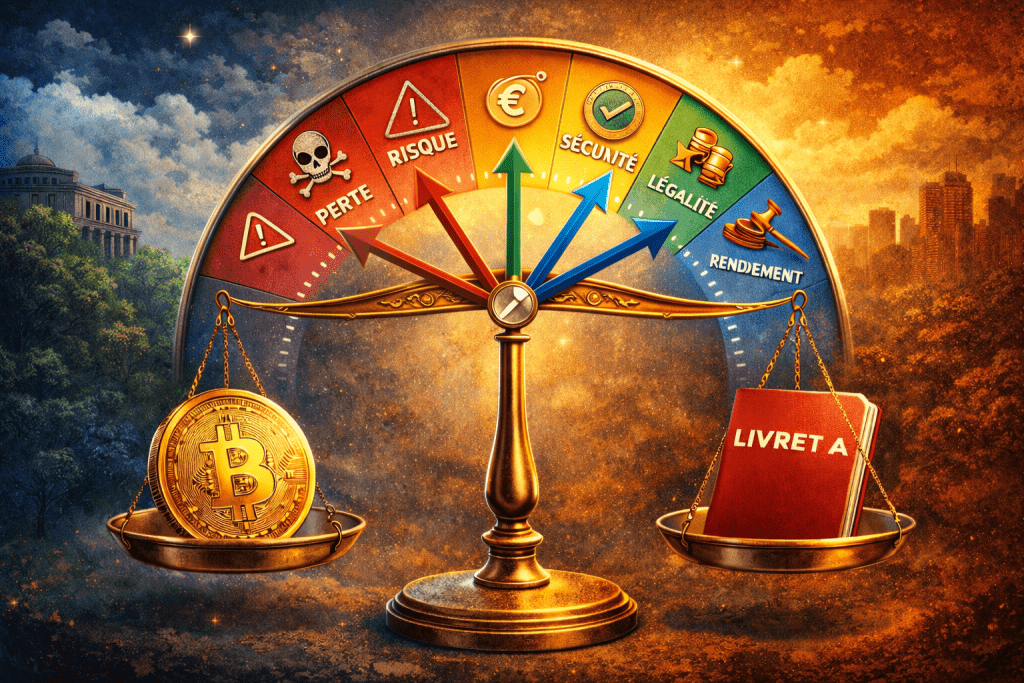
In 2026, CRYPTOCURRENCY is no longer the total Wild West of the early days. But it’s not a Livret A either.
It’s a volatile market, a technology, an economic ecosystem, and a legal framework that keeps getting clearer. And right in the middle of it: you, your goals, your emotions, and your ability to not do something stupid.
So here, I’m not going to tell you “buy this”. I’m going to do better:
The questions to ask BEFORE investing
Because if you ask yourself the right questions, you massively reduce your chances of losing everything.
1) Why do you want to do crypto?
The question sounds simple. In reality, it’s the most important question on the entire page.
Because there isn’t “the right crypto investment”.
There is:
- a goal
- a time horizon
- an acceptable level of risk
- a personality
- and only then… a choice of investment method and assets
Case #1: “I want to buy a car in 6 months”
I’m going to be direct: crypto is not the most logical place for that.
Why? Because in 6 months, you can get:
- +20%
- -20%
- or -60% on some assets
And if your project is “car”, your tolerance for loss is usually very low.
Case #2: “I want to build something over 10 to 30 years”
Now that starts to look like a coherent approach.
In that case, BITCOIN is often seen as a “digital reserve” (not magical, not perfect, but historically resilient). And ETHEREUM looks more like a bet on technological infrastructure (smart contracts, ecosystem, use cases).
Case #3: “I have €100 and I’d rather try this than buy scratch tickets”
Okay. That’s a “bet you fully accept” logic.
In that case, yes, a MEME COIN or a highly speculative project can theoretically do x10 / x100…
But the reality is: the most likely scenario is dilution, stagnation, or near-total loss.
And that’s not “bad” if you accept it from the start. The problem is when it’s disguised as a “serious” investment.
Conclusion of this section:
The goal isn’t to pick a crypto. The goal is to pick a strategy that fits your life.
2) BITCOIN, ETHEREUM and altcoins: you’re not buying the same thing
A lot of beginners mix everything together.
They talk about “crypto” as if everything had the same role.
In practice:
- BITCOIN: “reserve” vision, scarcity, security, the strongest network.
- ETHEREUM: “infrastructure” vision, SMART CONTRACT, ecosystem, innovation.
- ALTCOINS: everything else… from genius to absolute trash, sometimes in the same week.
One key point: a “good technical project” can flop. And a “objectively questionable” project can outperform during a hype phase.
Crypto is also a psychological market. And the market sometimes has zero desire to be reasonable.
When you buy a stock, you’re betting on a company (management, revenue, market).
When you buy many cryptos, you’re betting on a TECHNOLOGY… and the “company” is built around it.
That doesn’t mean it’s better or worse. It means it’s different.
3) The legal framework in 2026: crypto is growing, so it’s being regulated
Crypto has grown. Politicians have therefore started to regulate it.
And honestly: that’s not illogical.
When a market is worth hundreds of billions, when people get wrecked by scams, when platforms collapse… the State isn’t going to say “okay cool, keep going”.
So yes: there are laws. Not always the best ones. But often far from the worst.
Europe: MiCA
MICA aims to make the framework clearer: regulation of actors, transparency requirements, stablecoins, protections. It’s not perfect, but it pushes toward a more mature market.
France: AMF, registrations, compliance
In France, the logic is: “if you want to offer crypto services, you must operate within a framework”. So AMF, registrations, requirements… the idea is to reduce certain abuses.
That doesn’t remove the risk of loss. It reduces certain structural risks.
Taxation: the 30% slap
In France, crypto capital gains taxation is often summed up as: 30%.
Simple examples:
- You invest €1000 → you cash out €1100 → you owe about €30 in tax.
- You invest €100 → you cash out €1100 → you owe about €300 in tax.
That changes your strategy. Especially if you’re in a “small repeated gains” mindset.
And it’s even more true if you use STABLECOINS in DEFI with a “fixed” yield. Because no: that’s not an upgraded Livret A. It’s a setup with multiple layers of risk (I’ll come back to it later).
The role of voices from the industry (not just “influencers”)
Some people actually work the subject seriously, and fight for a clear, realistic framework that isn’t absurd.
Profiles like Owen Simon and Maxime Chery, who aren’t only “faces”: they’re also crypto entrepreneurs, directly impacted by the laws. And they meet politicians from all sides to explain, defend, correct, and propose solutions.
That matters. Because if the debate is left only to people who don’t understand the tech, we end up with rules that don’t match reality.
Now, let’s ask a legitimate question (for real)
If you test dozens of projects, open wallets to mine for a few hours, collect a few tokens via CRYPTO FAUCETS, do you have to declare every single wallet individually?
If you have 50 wallets containing:
- 10 SHIBA
- 100 LUNC
- 0.0001 ETH
- 1 experimental token
The administrative burden can become totally disproportionate compared to the amounts involved.
And here’s the dilemma, stated simply, without drama:
Do I follow the law and declare every single wallet I own — in which case I’ll spend hours on it, and the administration will spend hours on it too —
or do I put myself outside the law, not declare everything, and therefore be in violation?
This is not an attack. It’s a question of proportionality.
And that’s where absurdity becomes useful to understand the problem:
If a rule turns €1 micro-tests into an administrative marathon, the rule no longer filters “risk”, it filters “curiosity”.
In other words: a law designed to regulate large volumes can become heavy when applied to micro-experiments.
And if you’ve been in crypto for 10 years, with hundreds of wallets, mining, tests, airdrops… I’ll let you imagine the size of the file and the mood when filling all that out.
4) How to invest in crypto in 2026 (and why the method changes your risk)
This part is essential. And it’s often badly explained.
Because there’s a dangerous illusion:
“I bought crypto.”
Okay. But how? Where? With what level of control? What level of responsibility?
In 2026, you have several possible paths. I’ll rank them from the most “assisted” to the most “autonomous”.
And remember this:
The simpler it is, the more you delegate.
The more you delegate, the more control you give up.
The more control you want, the more you must handle the technical side.
1) Traditional bank: “clean exposure”, but not native crypto
Going through a bank often means choosing:
- simplicity
- a heavily regulated environment
- and sometimes exposure products (ETFs, structured products)
Pros:
- easy user experience
- you stay in an environment you know
- less technical management
Cons:
- you’re not “in” crypto: you’re exposed through a product
- you can’t use the ecosystem (DEX, DeFi, on-chain staking)
- you delegate almost everything (custody, access, rules)
For who? For someone who wants exposure without technical involvement.
2) ETF BITCOIN / ETF ETHEREUM: classic market wrapper, crypto asset inside
The ETF is the bridge between traditional markets and crypto.
Pros:
- no wallet to manage
- no seed phrase
- classic-investor approach
Cons:
- you don’t own the on-chain asset
- no DeFi usage
- you depend on the manager
For who? For someone who wants BITCOIN or ETHEREUM like a stock-market investment.
3) Neobanks (REVOLUT, N26): crypto “in a display window”
Neobanks make it extremely simple. Sometimes too simple.
Pros:
- very accessible
- clean interface
- perfect to discover the basic mechanics
Cons:
- often custodial: you don’t really control your keys
- on-chain withdrawals can be limited depending on assets
- simplicity can come with fees/spreads
For who? To test without drowning. But at some point, if you want “real crypto”, you’ll have to leave the display window.
4) CEX: the crypto highway (simple, liquid, but centralized)
A CEX (centralized exchange) like BINANCE, BYBIT, KUCOIN, BITGET… is often the most common entry point.
Why it’s popular:
- you deposit
- you buy
- you sell
- you have orders (limit, stop, etc.)
- liquidity is usually strong
Pros:
- easy
- liquid
- many assets available
- trading tools
Cons:
- custodial: your coins are “with them”
- freeze risk (KYC, blocks, compliance)
- platform risk (hack, bankruptcy, mismanagement)
- regulatory risk: a platform can become harder to use depending on your country
And yes, in France, that framework matters: if compliance isn’t aligned, using KUCOIN or BITGET can become more problematic for a French resident depending on the period and how regulations evolve.
Golden rule:
A CEX is a tool to buy/sell, not necessarily a long-term vault.
Because:
Not your keys, not your crypto.
5) DEX: total freedom (therefore total responsibility)
A DEX (Uniswap, PancakeSwap…) isn’t a “classic company”.
It’s code, SMART CONTRACT, and automated market logic.
Pros:
- you keep your funds in your wallet
- no central account
- access to tokens sometimes not listed on CEXs
Cons:
- if you send to the wrong address/network, nobody saves you
- smart contract risk (exploit, bug)
- more scams (fake tokens, rug pulls)
- 100% responsibility on you
A DEX is a bit like driving without insurance: not “bad”, but you must understand that mistakes don’t get forgiven.
6) Non-custodial wallet: you are literally the bank
A non-custodial wallet is the real turning point.
No more “I have an account”.
Now it’s “I have keys”.
And a private key is not a password. It’s not resettable. It’s not “forgot password”.
If you lose your seed phrase, you lose your funds. Period.
So the question is simple:
You want more freedom? Fine. You want more freedom? Then you carry more responsibility.
7) Hardware wallet: the vault (but you are the guardian)
A hardware wallet is often the best long-term option for BITCOIN / ETHEREUM.
Pros:
- offline keys
- strong reduction of “internet hack” risk
- excellent for long-term storage
Cons:
- you must be rigorous
- seed phrase must be stored physically and safely
- one bad manipulation can be costly
In short: maximum security, but discipline required.
8) Stablecoins: “I want stability”… yes, but in dollars
STABLECOINS feel stable, especially when you’ve just survived an altcoin roller coaster.
But there’s an invisible trap:
A stablecoin pegged to the dollar exposes you to the dollar.
If you live in euros:
- if the dollar goes up, your value in euros goes up
- if the dollar goes down, your value in euros goes down
So you can be “stable” in USDT… and still move in EUR.
And on top of that:
- issuer risk
- regulatory risk (US/EU)
- risk if you then deploy into DEFI
Stablecoin doesn’t mean “risk-free”. It means “different risk”.
9) DeFi: possible yield, but not free
DEFI can offer yields.
But a yield is never free: it pays for risk.
Typical risks:
- smart contract (bug/exploit)
- protocol risk (bad design, bad governance)
- stablecoin risk
- liquidity risk
DeFi is powerful. But it’s not “easy”.
10) Trading bots: useful tool, not a magic wand
A bot can:
- automate a strategy
- reduce some emotional mistakes
- produce “small regular percentages” in certain market conditions
But a bot cannot:
- remove volatility
- cancel a crash
- remove platform risk
So yes, it’s a tool. But it’s not a guarantee.
Conclusion: the right method is the one you can actually handle
In the end, the goal is that you can say:
- “I want to delegate and sleep: BANK / ETF / NEOBANK”
- “I want to buy easily: CEX, then I withdraw to a WALLET”
- “I want sovereignty: DEX + NON-CUSTODIAL + discipline”
- “I want to optimize: stablecoin / DeFi, while understanding the risks”
And if you think: “I need to think a bit more”… that’s perfect.
5) Fantasy vs reality: the cousin, the Porsche, and the wall
We’ve all heard the story:
“My cousin put €200 into something, now he did x1000.”
And then he gives you a strategy tip:
“Sell your car before summer. When you come back from vacation, Porsche.”
So yes: some people made fortunes by putting a small amount at the right time.
But the reality is also:
- people who lost a lot
- projects that go to zero
- cycles where everyone is a genius… then nobody is
Simple example:
€10 invested in ETHEREUM very early doesn’t have the same trajectory as €10 invested at the peak of euphoria.
Timing matters. Psychology matters. Risk management matters.
And yes: a large part of investors lose money.
But if today companies and states are interested in crypto, it’s not because they love risk for fun.
It’s because the framework is becoming clearer, infrastructures are stronger, and structural risk is decreasing.
That doesn’t remove market risk. It makes it more “understandable”.
6) Every investment has a different purpose (and that’s what makes crypto interesting)
People often mix everything up, while in reality, you can have several “crypto strategies” at the same time.
Here are my examples — explained clearly this time:
LUNC: the accepted lottery ticket (the money was already lost)
I invested in LUNC at the end of its crash.
In my head, it was a lottery ticket: that money was already lost from the start.
So psychologically, it’s different:
- I don’t count on it
- I don’t panic
- I don’t pretend it’s a “safe” strategy
And today? I neither gained nor lost.
It’s still there. Tomorrow, I don’t know.
Like many people, I hope LUNC will recover: strong community, interesting prospects… I “half-believe” in it, but I don’t care: the money was already considered lost.
The baby: birth gift, blindfold on
I put €40 into five cryptos for a baby, as a birth gift.
It’s not me deciding what happens next.
I invested the amount, then I put a blindfold on.
The account is basically “vegetative”.
He will open it in 15 years, 18 years, 30 years… and see what happened:
- maybe zero
- maybe enough for a driving license
- maybe more
That’s the concept: a risky gift, but potentially memorable.
Bots: small profits, gradual withdrawals, concrete objective
I used trading bots to generate small profits.
Not to get rich.
But as a tool:
- the money stayed fairly stable
- I withdrew gradually when I needed it
- it helped with hard hits (vet bills, unexpected costs)
It didn’t generate huge gains.
But it was higher than a Livret A, with more flexibility… and most importantly, aligned with a real need.
Conclusion: every investment deserves a purpose, and every purpose deserves its own follow-up style.
7) Follow-up: -20%, -40%, -70%… and your brain trying to sabotage you
Crypto doesn’t destroy people because of technology.
It destroys them because of psychology.
One essential point:
-40% on BITCOIN with a 20-year horizon does not mean the same thing as -40% on a random altcoin.
But there is a very important nuance:
If BITCOIN does -40% because the market breathes, okay.
If BITCOIN does -40% because a major technical flaw is discovered and threatens the protocol… that’s a different universe.
So we’re not telling you “never open your apps”.
We’re telling you:
- don’t panic over normal fluctuations
- but keep an intelligent eye on structural risks
For a speculative altcoin:
- you must have an exit plan
- you must know why you entered
- you must accept it can go to zero
For a long-term investment:
- gradual entry strategy (DCA)
- emotional management
- clear horizon
And I’ll leave you with a simple but true sentence:
It’s not the drop that destroys investors.
It’s their reaction to the drop.
Conclusion: yes, this is investment advice
I’m going to take the opposite approach to the automatic phrases you see everywhere.
Yes, this is investment advice.
My advice is simple:
Be careful what you do.
You can win.
You can lose everything.
Crypto is not a Livret A.
It’s not a scratch ticket.
It’s a technology on which economic systems are being built. And depending on your goal, it can be:
- a long-term investment (BITCOIN)
- a technology bet (ETHEREUM)
- an accepted speculation (ALTCOINS / MEME COINS)
- a tool (bots, stablecoins, DeFi)
So start small.
Choose your level of responsibility.
And do your DYOR (yes, for real).
Then go read our dedicated pages: BITCOIN, ETHEREUM, DYNEX, CENTRALIZED EXCHANGE, CEX, DEX, CRYPTO FAUCETS, STAKING, NFT, MOVE TO EARN… and come back with a strategy, not an impulse.
Because the best way to avoid losing everything… is to not start like a tourist.